
Johnson City · Washington County · Tennessee
Well Water Testing & Treatment in Johnson City, TN
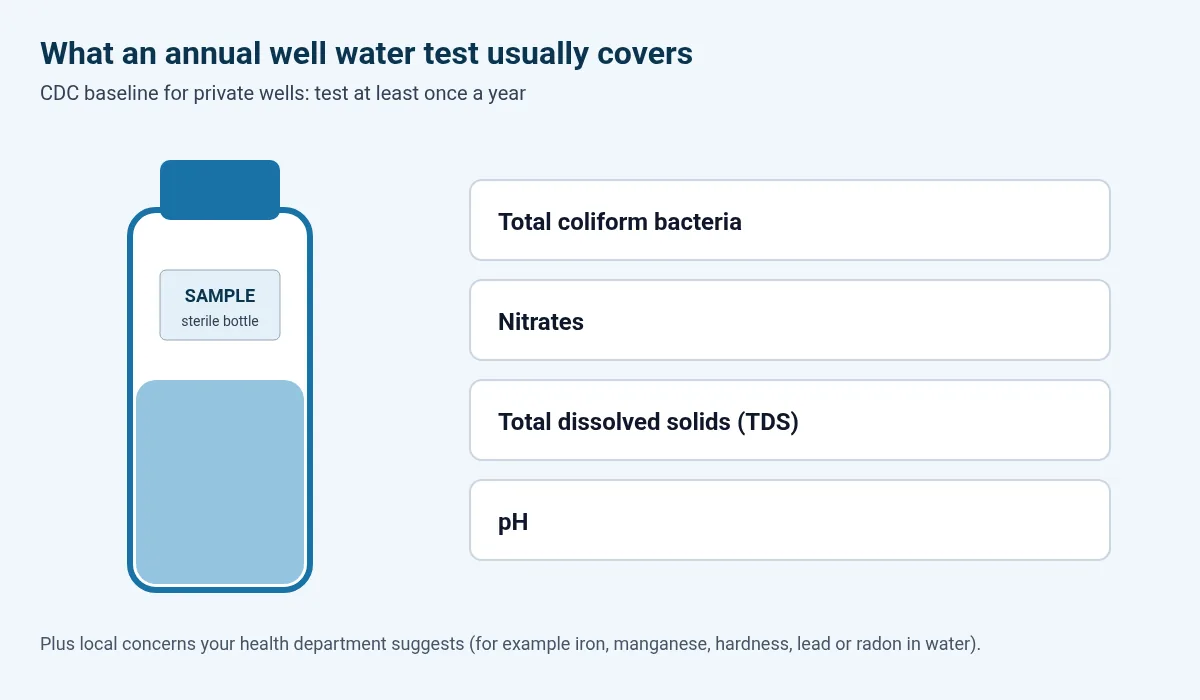
Tennessee does not require private well testing, so it’s up to you. TDEC strongly recommends a bacteria test every year (TDEC), and the CDC adds nitrates, total dissolved solids and pH to the yearly list (CDC). We connect Johnson City-area owners with an independent local well & water professional for sampling, a pre-sale check or treatment.
Free for homeowners. We don’t charge you for the referral; the local pros we connect you with pay us.
- Free for homeowners
- Yearly bacteria test
- Treatment matched to results
Want your well water checked?
Tell us what is happening and your ZIP. We will connect you with an independent local well & pump professional.
Which tests, and how often?
| Test | How often | Who recommends it |
|---|---|---|
| Total coliform bacteria | Every year | TDEC; CDC |
| Nitrates, total dissolved solids, pH | Every year | CDC |
| Bacteria again | After any pump, pipe or casing work, and after disinfection | EPA; TDEC |
| Hardness (for scale and softener decisions) | Once, then as needed | Local concern: most area samples over 100 ppm (USGS) |
Why karst makes the yearly bacteria test worth it here
Parts of the area, including land south of Elizabethton and east of Johnson City, show early karst topography, and some sinkholes south of Elizabethton cover more than 10 acres (USGS WSP 1460-J). Across the Valley and Ridge, the USGS warns that where the soil over the limestone is thin, fractures and solution openings let groundwater move quickly and leave aquifers susceptible to contamination from septic systems, storage tanks and waste sites (USGS HA 730-K).
Surface water can reach a well faster in that kind of rock than it would through thick soil, which is why a test after heavy rain or flooding is also sensible.
Where to get a sample tested near Johnson City
- State-certified private labs. TDEC’s Laboratory Certification Program lists private labs certified for drinking water (TDEC).
- TDEC Johnson City Environmental Field Office, 2305 Silverdale Drive, Johnson City, TN 37601; (423) 854-5400. It serves Carter, Greene, Hancock, Hawkins, Johnson, Sullivan, Unicoi and Washington counties (TDEC).
- A well & water professional can collect the sample, inspect the wellhead and explain the results. We can connect you with an independent local pro.
If bacteria show up: what TDEC’s disinfection involves
TDEC’s published procedure uses one gallon of chlorine bleach (or one ounce of HTH) per 50 feet of well depth, runs every faucet until chlorine is smelled, then leaves the water in the well and pipes for at least 12 hours before pumping it out until the odor is gone. TDEC warns not to run heavily chlorinated water through a septic system or into a stream (TDEC). Retest afterward. If bacteria keep coming back, TDEC says a permanent chlorinator or ultraviolet light may be needed.
For hardness, a softener is the usual fix; for low pH, iron or odor, match the equipment to the lab result. Angi puts well water treatment systems at an average of $2,300 nationally, most $1,200 to $3,600, and water testing at $50 to $300 per test (Angi).
Frequently asked questions
Does Tennessee require a well test when a house is sold?
No. TDEC says Tennessee has no requirements for sampling private water supplies; ask whoever requires the test, usually the lender, which tests they need (TDEC).
Who answers bacteria-testing questions locally?
TDEC directs total coliform questions to its Environmental Field Office. For this area that’s the Johnson City office at (423) 854-5400 (TDEC).
Due for a yearly test? We’ll connect you.
Call or send the form and an independent local pro can sample, inspect the wellhead and explain the results. Free for homeowners: the local pros pay us, you don’t.
Call (423) 872-2950 Request by Form