It has been short-cycling for days
A pressure tank exists so the pump starts less often and lasts longer, and starting a pump takes more energy than keeping it running (UNL Extension). Constant starts wear the motor and the switch.

Johnson City · Washington County · Tennessee
Weak pressure plus a pump that kicks on and off every few seconds usually points to the pressure tank: when a tank becomes waterlogged there is little air left to compress, so the pump runs nearly every time water is used (UNL Extension). A worn or scaled pressure switch, a leak, a tired pump or a well drawing down in dry weather can look similar. Read the gauge, try the safe checks below, then call: we connect Johnson City-area homeowners with an independent local well & pump professional.
Free for homeowners. We don’t charge you for the referral; the local pros we connect you with pay us.
Tell us what is happening and your ZIP. We will connect you with an independent local well & pump professional.
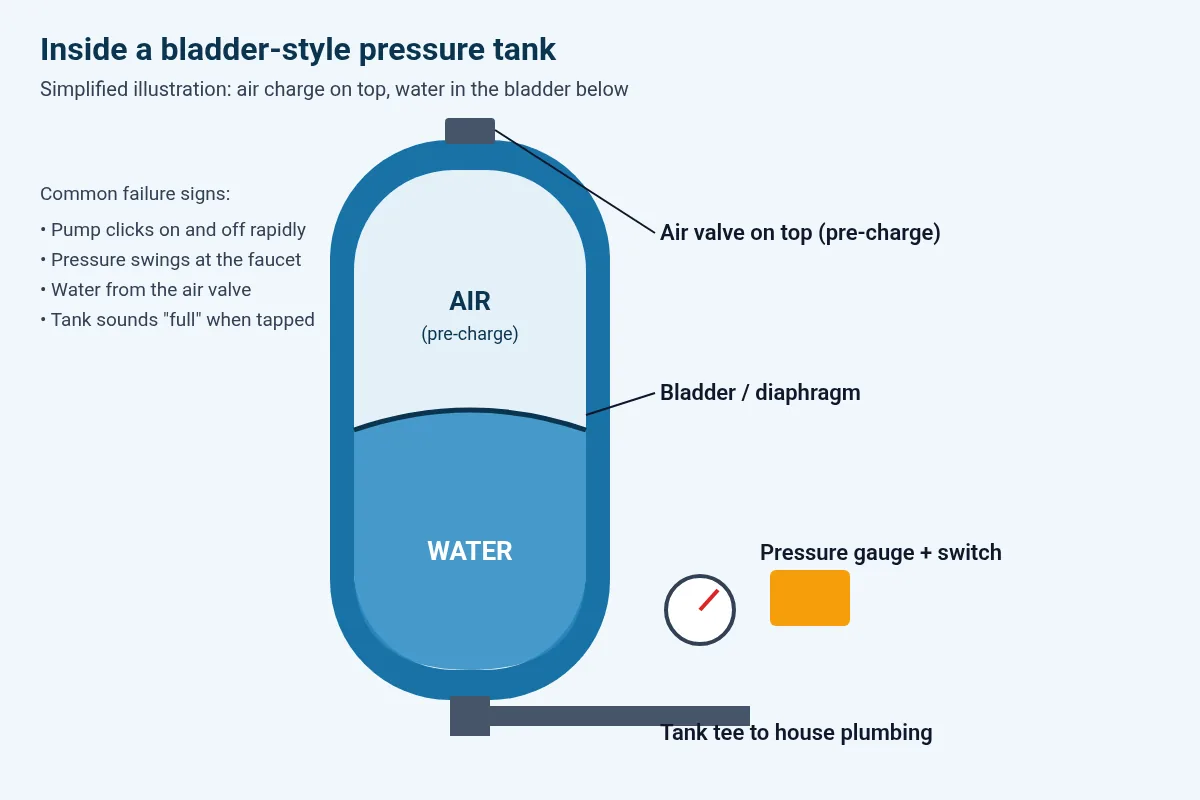
On a standard system the pressure switch starts the pump at a preset low point, typically 20 to 40 psi, and stops it at a preset high point, typically 40 to 60 psi. Water softeners, treatment units, clothes washers and dishwashers need at least 30 psi to work properly (UNL Extension). So a 30/50 system that sags into the 20s, or a 40/60 system that never climbs past the mid-40s, deserves a closer look.
The tank holds only a few gallons between pump starts. In the University of Nebraska figures, a 30-gallon bladder tank delivers about 5.1 gallons on a 20/40 switch, 4.3 on 30/50 and 3.7 on 40/60 (UNL Extension, from MidWest Plan Service data). Angi says a pump should generally cycle every few minutes (Angi). If yours starts within seconds of opening a tap and stops seconds later, it is short-cycling.
| What you notice | Likely cause | What it means |
|---|---|---|
| Pump starts seconds after a tap opens and stops seconds later | Pressure tank waterlogged, or its air charge lost | Most makers recommend an air charge about 2 psi below the pump-on pressure (UNL); a pro checks it with the tank drained. More on our pressure tank page. |
| Gauge jumps, or the switch chatters | Worn switch contacts, or scale in the small tube that feeds the switch | Common on hard water; most local samples topped 100 ppm hardness (USGS). Angi puts a switch repair at $120–$175 (Angi). |
| Pump turns on with every faucet closed, or won’t shut off | A leak somewhere in the system, or a tank problem | Angi warns a pump that runs nonstop because of a leak or tank problem can fail (Angi). Check toilets and outside spigots, and walk the line to the well. |
| Pressure fades, taps spit air, the pump runs long | A well drawing down, a pump losing capacity, or a pump sized wrong | Angi lists the tank, low water levels and a wrong-sized pump as causes of low pressure, and air in the pipes as a pump warning sign (Angi; Angi). Local water tables are lowest in late fall (USGS). |
| Above-ground pump hums but pressure won’t build | A jet pump that has lost its prime | An air leak in the suction pipe or a water leak in the drop pipe costs a jet pump its prime (UNL). See jet pumps and shallow wells. |
| Gritty or cloudy water along with weak flow | Sediment reaching the pump or plumbing | Angi notes sediment buildup can make a pump seize (Angi). Cloudiness after hard rain is also a reason to test for bacteria in karst country (USGS). |
| Weak flow at one faucet or shower only | That fixture or the house plumbing, not the well | A poorly designed or aging plumbing system can leave fixtures short even when the well and pump are fine (UNL). |
Six checks that don’t involve opening anything electrical. Write down what you find; it shortens the diagnosis.
Leave these to the pro: checking or adding air to the tank means shutting the pump off and draining the system first, and the pressure switch sits next to live terminals. In Tennessee, installing or repairing well pumps is licensed work under TDEC rules (TDEC), so leave the tank valve, switch and control box alone.
A pressure tank exists so the pump starts less often and lasts longer, and starting a pump takes more energy than keeping it running (UNL Extension). Constant starts wear the motor and the switch.
If nothing in the house is running and the pump keeps going, there is a leak or a pump that can’t reach its cut-off pressure. Angi warns that can end in pump failure (Angi).
That has become a no-water call. Follow our no-water checklist: reset the breaker once, then call.
Sputtering, cloudy or gritty water alongside low pressure points at the pump or the well. The EPA advises testing the water after any pump, pipe or casing repair (EPA).
Most short-cycling and pressure problems end with a part, not a pump. Angi’s 2026 national figures: pressure switch $120–$175, pressure gauge $100–$175, control box $200–$500, and a new pressure tank $500 on average, most $300–$700 (Angi repair; Angi tank). A full pump replacement averages $1,897 (Angi). Every part is broken out on our well pump repair cost page.
If you want steadier pressure rather than just a repair, ask about a constant-pressure system. A variable-speed controller changes the pump’s speed to hold pressure, so the pump starts less often and needs only a small tank, usually 1 to 2 gallons (UNL). Angi lists constant-pressure pumps at $1,300–$4,000+ installed (Angi).
Raising the switch setting is one way Angi lists to get more pressure (Angi), but it doesn’t cure short-cycling. The tank’s air charge has to be reset to match, about 2 psi below the new pump-on pressure (UNL), and the pump has to be able to reach the new cut-off. In Tennessee that adjustment is pump work for a TDEC-licensed installer (TDEC).
Over time, yes. The tank’s job is to let the pump start less often, which prolongs its life (UNL Extension). Frequent starts also pit and wear the switch contacts.
Maybe. UNL’s rule of thumb sizes a bladder tank at about four times the pump’s flow rate, so a 9-gallon-per-minute pump pairs with roughly a 36-gallon tank; it also notes bladder tanks may not suit low-yield wells without an extra tank (UNL). A bigger tank won’t raise pressure by itself (Angi).
It may be the well rather than the equipment. The USGS found the water table around Elizabethton and Johnson City lowest in late fall, with some dug wells going dry (USGS WSP 1460-J). A pro can measure the water level before you pay for a part you don’t need.
Often a few hundred dollars for a switch or a tank, based on Angi’s 2026 national ranges (Angi). Our cost page lists each part.
Free for homeowners. We don’t charge you anything for the referral. The independent local professionals we connect you with pay us for referrals, and you’re never obligated to hire them. Ask the pro for a written price before any work starts.
Call or send the form with your gauge readings. We’ll connect you with an independent local well & pump professional. Free for homeowners: the local pros pay us, you don’t.
Call (423) 670-8500 Request by Form