Waterlogged tank
Knocking sounds solid all the way up; the pump cycles every few seconds. The bladder may have failed.

Johnson City · Washington County · Tennessee
If your Johnson City-area well pump clicks on every few seconds, pressure surges at the shower, or the tank sounds full of water when you knock on it, the pressure tank or switch is the likely suspect. Angi puts the national average tank replacement at $500, most $300 to $700 (Angi). We connect you with an independent local well & pump pro.
Free for homeowners. We don’t charge you for the referral; the local pros we connect you with pay us.
Tell us what is happening and your ZIP. We will connect you with an independent local well & pump professional.
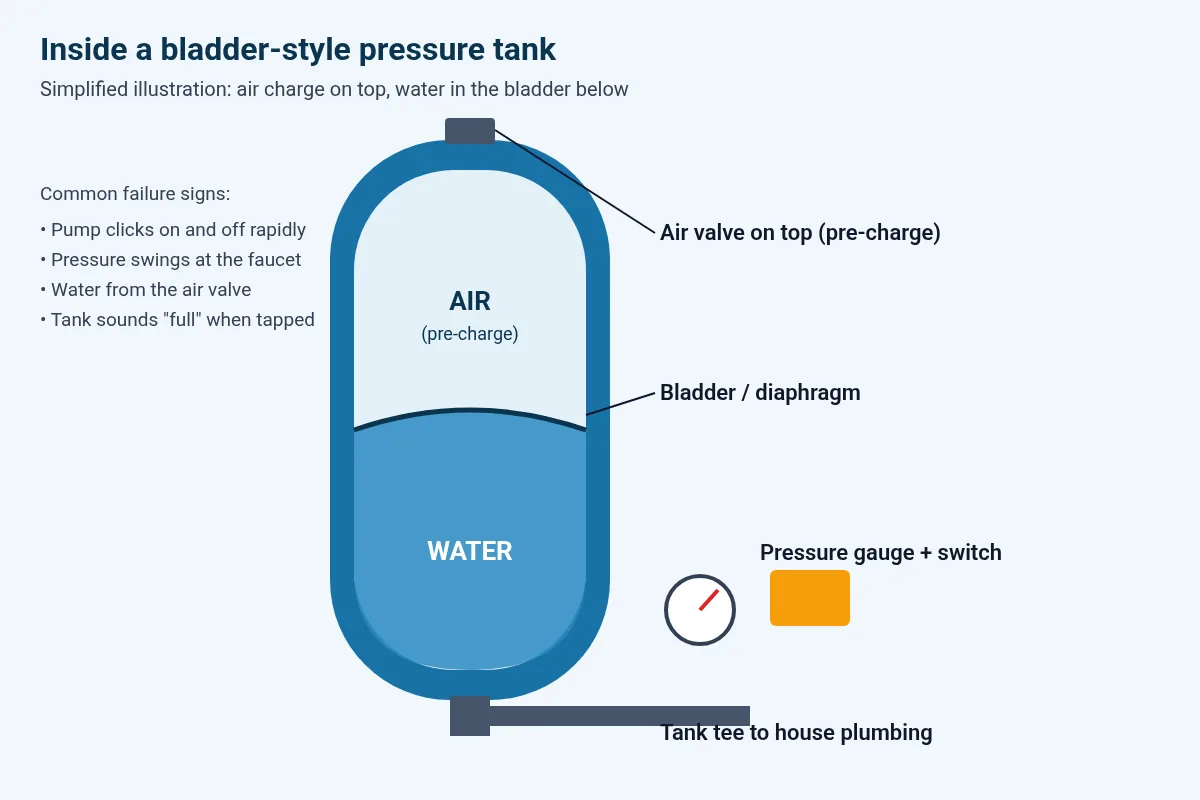
A captive-air tank holds a cushion of compressed air above a bladder or diaphragm. As you draw water, pressure falls until the switch starts the pump; the pump refills the tank and the switch shuts it off. When the air cushion is lost, the tank fills with water, the pressure drops almost instantly and the pump starts and stops constantly. That short cycling is hard on the motor.
Hard water adds a Tennessee twist. Most groundwater sampled around Elizabethton and Johnson City was harder than 100 ppm (USGS), and scale can narrow the small tube that feeds the switch, so the switch misreads pressure. A pro will usually clean or replace that tube along with the switch.
Knocking sounds solid all the way up; the pump cycles every few seconds. The bladder may have failed.
The pump starts late, stops early or chatters. Switch replacement is usually a small job on its own.
TDEC says the pump and storage tank should be sized to the well’s yield and the household (TDEC). A low-yield well may need more storage.
Water around the tank base or tank tee. Mineral crust around a fitting is a clue.
| Tank type | Typical price (national) | Trade-off |
|---|---|---|
| Diaphragm (welded membrane) | $200–$500; up to $2,500 for 120-gallon or all-metal | Efficient; the membrane is sealed in |
| Bladder | $150–$400; up to $1,500 large | Inner bladder easier to replace, can lose air over time |
| One-compartment | $100–$300 | No bladder to fail, but higher waterlogging risk |
| Labor to swap a tank | $125–$200 | More for hard-to-reach tanks |
Source: Angi well pressure tank replacement cost guide, Sept. 18, 2026. Tanks run about $10–$15 per gallon, from 20 to 120 gallons.
No. Angi notes a larger tank does not raise water pressure by itself; the pressure switch setting does. What a bigger tank does is store more water between pump starts, so the pump cycles less often and lasts longer (Angi). If you want steadier pressure, a constant-pressure system is another option to ask about.
A quick clue from a plumber quoted by Angi: open a faucet. If the pump kicks on almost as soon as water runs, the tank is likely bad (Angi).
Only if both are worn. Angi notes that with a combination pump-and-tank system, replacing the whole system is often cheaper than one part, and if the pump fails during a tank job, the average pump replacement is about $1,900 (Angi).
On hard water, scale in the switch tube and on the contacts is a common reason. Groundwater here is typically over 100 ppm hardness (USGS). Short cycling from a waterlogged tank also wears switches quickly.
Call or send the form and we’ll connect you with an independent pro who can check the tank, switch and gauge. Free for homeowners: the local pros pay us, you don’t.
Call (423) 872-2950 Request by Form